

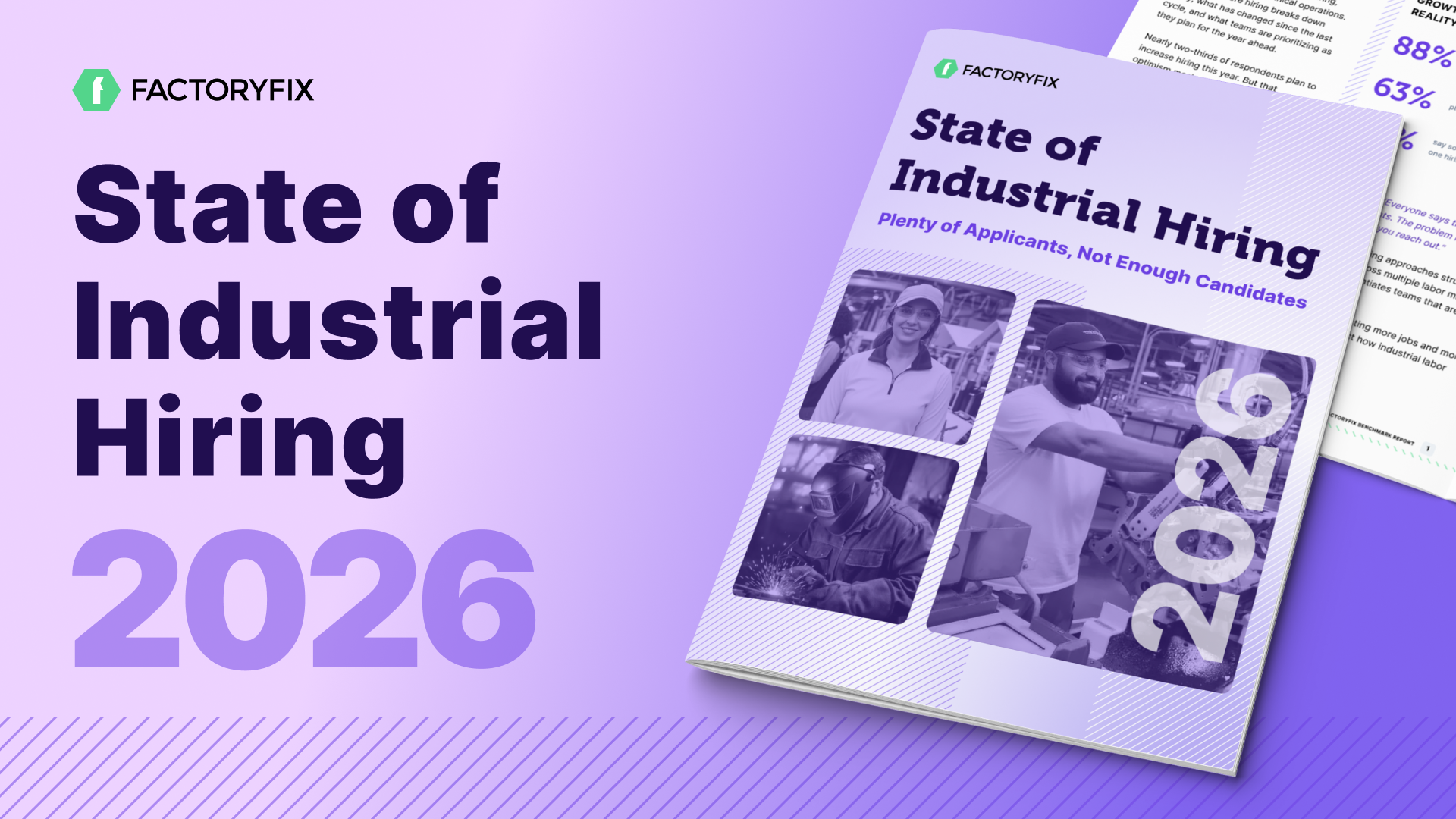
Every year, industrial hiring teams operate on assumptions. Assumptions about how long it should take to fill a role, how many applicants they need to find a qualified one, which sourcing channels are worth the investment, and how their results compare to everyone else in the market.
Most of those assumptions are wrong, or at least unverified. Industry benchmarks for industrial hiring have historically been thin, generic, or built from data that has nothing to do with manufacturing and skilled trades. We built this report to change that.
We surveyed 83 industrial hiring professionals, analyzed over 1.2 million applications from 2025, and pulled federal labor data across 18 industrial occupations. Download the FactoryFix 2026 State of Industrial Hiring Report to see where hiring pipelines are breaking down, how fast top-performing teams are moving from application to interview, which trades are getting harder to fill and why, and where your peers are putting their recruiting effort in 2026.
Here's what the data showed.
More applicants won't solve a quality problem.
65% of hiring leaders say sourcing qualified candidates is their number one bottleneck. As one staffing leader put it:
"Everyone says they can't find people, but that's not really the problem. We get plenty of applicants. The problem is finding candidates who are actually qualified and willing to engage once you reach out."
For skilled trades especially, most of the people you want are already employed and not actively looking. The teams making progress have built sourcing approaches that reach those candidates rather than waiting for them to apply.
See the full sourcing data in the report →
Your process speed is either winning or losing candidates for you.
The median time from application to first interview is 2 to 3 days. By day 8, three out of four successful hires have already moved faster than that. When qualified candidates are fielding multiple opportunities at once, a slow process costs you people you already found.
"If you're pushing the process out two to three weeks, that person loses interest. Especially when there's five jobs to one qualified person. You need to get that person in the door within a couple of days." — Recruitment Strategist, National RPO
See the full sourcing data in the report →
Some roles are getting harder regardless of what you do with your process.
52.8% of tool and die makers are 55 or older. For every one person entering the trade, 3.8 are approaching retirement. Machinists and maintenance techs show similar pressure. Compensation can help at the margins, but it can't fix a shrinking supply. As one recruiter told us:
"The folks that are more seasoned, that have been in the industry a little bit longer, they expect that higher pay. And it's just not there right now. So they're staying put." — Recruitment Strategist, National RPO
Understanding which of your open roles sit in this category changes how you plan for them and how much lead time you actually need.
See the full sourcing data in the report →
Quality has become the priority.
47.6% of hiring leaders named improving candidate quality their top goal for 2026, well ahead of speed or cost reduction. The teams seeing better outcomes are investing more time upfront in defining what qualified looks like before a role is posted.
"We've had to get much clearer about what the role actually requires and be more deliberate in how we screen. Taking a little more time early on has helped us avoid rework and turnover later." — Ashley Vogel, HR Manager, Innovative Machine Specialists
The full report includes time-to-fill benchmarks by role tier, workforce replacement data by occupation, and a full breakdown of where 83 of your peers are focusing their hiring effort this year.
[Download the 2026 State of Industrial Hiring Report]
.svg)


