

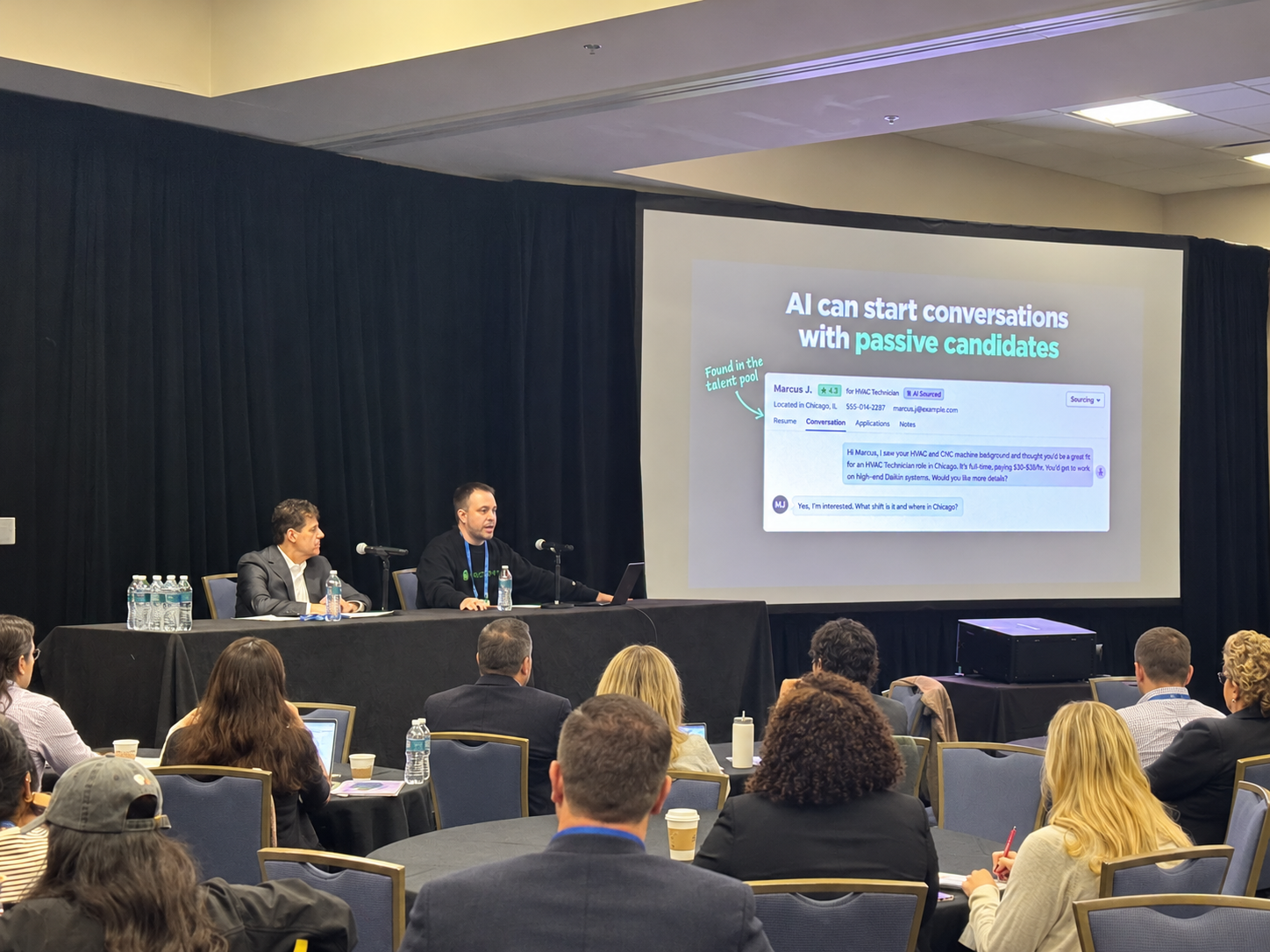
The best welder, machinist or maintenance tech you’ll place this year might not be reading your job posting. They’re on a shop floor mid-shift, reasonably happy, with an outdated resume and no idea your client is hiring. If your recruiting starts and ends with a posting, they may never hear from you.
That’s not a hunch. In Workable’s survey of U.S. workers, 37% described themselves as passive candidates: employed, open to a new opportunity, and not actively looking.
At ASA Staffing World in Denver, Larry Marion, VP of Franchise Relations at AtWork, and Patrick O’Rahilly, Founder and CEO of FactoryFix, discussed practical ways to strengthen a staffing desk. Here are five takeaways for staffing and RPO teams.
1. Reach the candidates who aren’t applying
Teambridge’s 2025 survey of more than 1,000 hourly workers found that only 29% were likely to stay with their current employer over the next year. Being open to leaving isn’t the same as actively applying, though. And candidates respond on their own schedule: FactoryFix platform data showed that 30% of passive candidates contacted responded after 6 p.m. or over the weekend.
“Even for hourly recruiting, it’s going to look more like executive headhunting over time.”
Patrick’s point: don’t just post and wait. Hourly hiring is shifting from posting a job and waiting to something closer to executive search: you decide who you want, then contact them directly with a message about that specific role.
What you can do with this: Pick your three hardest roles and reach out to candidates who haven’t applied. Plan for replies outside office hours. FactoryFix’s AI recruiter can handle sourcing, personalized text and email outreach, and initial screening, so your team can focus on people who are interested and actually fit the role.
2. Treat your database like an asset you maintain
The median U.S. worker had been with their current employer for 3.9 years in January 2024, according to the Bureau of Labor Statistics. Contact information changes, too: email verification company ZeroBounce estimates that about 23% of an average email list goes bad each year.
“Do you have gold nuggets, or do you have gold dust?”
What this means: Larry’s question gets at the difference between a database you can use and one that only looks big. A strong candidate record loses value when you can’t reach the person or tell whether their experience is current.
What you can do with this: Start with your most placeable candidates. Verify contact details and update work history before you need them, then establish a recurring refresh. In FactoryFix, “unlocking a candidate” triggers a contact-data check across multiple sources.
3. Watch your postings in the first 48 hours
St. Louis Fed research covering about 80 million applications to nearly 10 million online postings found that 41% of applications arrived within 48 hours and 56% within 96 hours. The research predates today’s job boards and isn’t specific to hourly hiring, but it underscores why the first few days deserve attention.
For a job posted on Monday, a substantial share of applications could arrive by Wednesday. That makes the first draft count: a clear title, upfront pay and specific shift details help candidates decide whether to apply while the posting is still fresh.
What you can do with this: Assign someone to check posting performance at 48 hours. If response is weak, review the title, pay, shift and requirements rather than simply waiting. FactoryFix’s Optimize Visibility setting handles scheduled title and description variations, taking one recurring task off the desk.
4. Lead client conversations with market data
Clients ask what the going rate is for a forklift driver or an administrative assistant, and they expect you to know. Pay is also what candidates weigh most: in Employbridge’s 2023 Voice of the American Workforce survey, 67% of logistics workers and 61% of manufacturing workers named pay rate as the most important factor when looking for a new job.
When a client’s offer is below market, local evidence can turn “you need to raise the rate” into a shared look at the options. It also helps establish realistic expectations before a search stalls.
What you can do with this: Bring a labor market report to your next pricing or "why isn't this role filling" conversation, with pay ranges, candidate supply and who else is hiring. Local pay benchmarks, talent availability and hiring competition give you a concrete starting point for discussing what needs to change.
5. Turn candidates into new clients
Skill marketing means pitching a strong candidate to employers who might hire them, even when you don’t have an open order. Larry highlighted it as a business-development opportunity and offered another practical idea: use reference-check conversations to learn whether a company uses staffing services.
“If your firm is doing reference checks, it’s an opportunity for you to flip that into a sale.”
What this means: You don’t have to wait for a job order to start a useful client conversation. A strong candidate lets you lead with something concrete: “I’m working with a maintenance tech whose experience could fit your team,” rather than “Do you need staffing help?” That can open conversations with new accounts or uncover hiring needs an existing client hasn’t brought to you. The work you’ve already put into sourcing and screening becomes a business-development asset, even when the original opening isn’t a fit.
What you can do with this: Pick one strong candidate without a matching order and identify employers to approach. FactoryFix’s Job Match Report does the employer research for you: it finds nearby employers hiring for roles that fit a candidate’s background, with talking points on why they could be a match. You can start with a resume from your own database.
One more thing: it’s an “AND,” not an “OR”
AI came up throughout the session, and so did its limits. On candidate screening, both speakers said to use it to prioritize your time, not make the decision.
Patrick put it this way: “This is software that’s making you productive and giving you superpowers. It’s not a teammate.” In the Q&A, one attendee added that AI engagement should sound like your recruiters, use more than one channel, and tell candidates they’re talking to AI.
Larry’s closing advice: sort out your “need to haves” before your “nice to haves.” You only have so much budget.
Want to try it on one of your roles?
Bring us a role and a location. We’ll show you relevant candidates in FactoryFix’s 10M+ candidate network, plus a labor market report for your market.
See candidates and market data for your hardest role.


