

%20-%20web%20thumbnail%20(812%20x%20458%20px)%20(1920%20x%201080%20px).png)
The overall labor market cooled in 2025. Unemployment rose, job openings declined, and quit rates normalized after years of post-pandemic volatility. For hiring managers, this should have meant relief from the skilled trades shortage that dominated the previous few years. It didn't. Instead of broad improvement, hiring pressure concentrated into an even narrower set of critical roles. It’s now clear these aren't shortages that will fix themselves when economic conditions change.
Industrial Sector Snapshot: Conditions Heading into 2026
Based on BLS Employment Situation and JOLTS data across industrial sectors
Manufacturing
- Employment growth slowed over 2025 as payroll levels flattened compared to prior years
- Job openings declined steadily, signaling reduced hiring urgency rather than contraction
- Hiring activity shifted toward backfills and roles tied to uptime and reliability
Construction
- Employment continued to grow, but at a slower pace than earlier in the cycle
- Hiring rates cooled as higher borrowing costs delayed new projects
- Demand remained steady for skilled electrical and mechanical trades
Mining, quarrying, and oil and gas extraction
- Employment trends were mixed, reflecting uneven investment across energy segments
- Hiring activity remained uneven as companies adjusted capital priorities
- Demand persisted for specialized technical and field service roles
Transportation and warehousing
- Employment stabilized after several years of rapid expansion
- Job openings declined meaningfully from pandemic era highs
- Worker mobility slowed as quits moderated and employers focused on productivity
Utilities
- Employment remained relatively stable throughout 2025
- Hiring activity was steady but limited, reflecting long term workforce planning
- Competition remained concentrated in electrical, facilities, and maintenance roles
Skilled Trades Roles in Focus for 2026
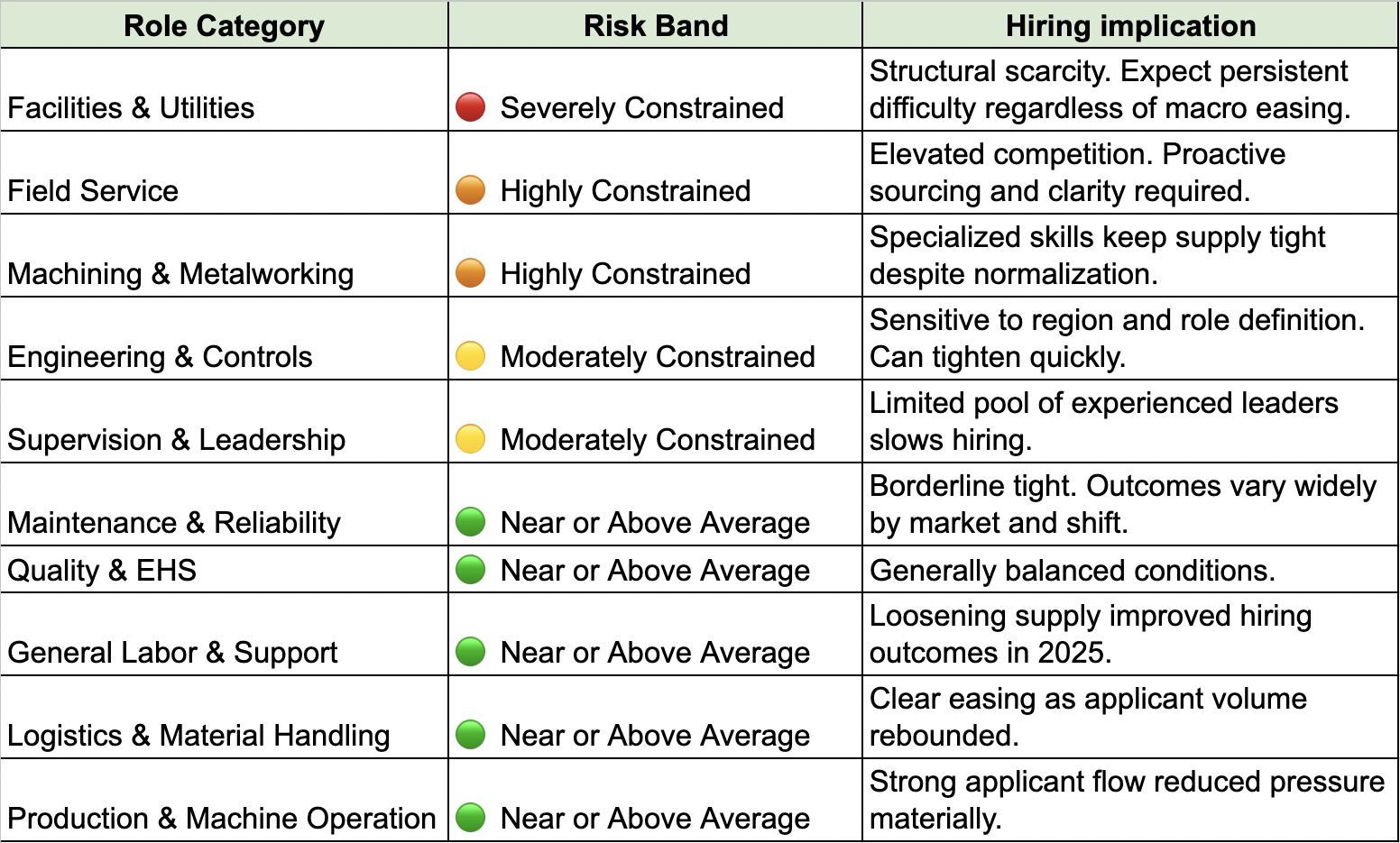
The role category risk bands highlight how hiring pressure re-sorted itself in 2025. As overall labor conditions normalized, constraint did not disappear. It concentrated into a narrower set of skilled trade roles that are critical to industrial operations and difficult to replace.
Facilities and utilities roles stand out as the most constrained heading into 2026. These positions remain well below the platform average for applicant supply and show little sensitivity to broader labor market easing. Demand in this category is driven by infrastructure reliability, regulatory requirements, and long replacement cycles, which limits the relief employers can expect from cooling demand elsewhere.
Field service roles continue to face elevated pressure. Travel requirements, geographic coverage, and customer facing expectations narrow the candidate pool, particularly in industrial dense regions. Even as application volume increased across the platform in 2025, field service roles did not see a comparable improvement, reinforcing the need for proactive sourcing and clear role definition.
Machining and metalworking roles remain highly constrained as well. CNC machinists, programmers, and related specialists require experience that cannot be quickly developed, and demand remains closely tied to advanced manufacturing and precision work. Hiring outcomes in 2026 will continue to hinge on specificity around equipment, tolerances, and shift structure.
A second tier of constraint appears in engineering and controls roles. These positions sit below the platform average for applicant supply but are more sensitive to execution. Markets with high automation investment or poorly defined searches can tighten quickly, while employers who clearly articulate systems, responsibilities, and growth paths tend to see better results.
Finally, maintenance and reliability roles sit near the platform average overall, but this masks wide variation by region and specialization. In markets with aging infrastructure or limited technical pipelines, these roles can behave more like highly constrained categories, particularly for multi skilled technicians with electrical or controls experience.
Taken together, these patterns set clear expectations for 2026. Skilled trade hiring risk is concentrated in roles tied directly to uptime, safety, and specialized technical knowledge. Employers that assume easing labor conditions will resolve these challenges are likely to face continued delays. The teams best positioned in 2026 will be those that plan early, define requirements precisely, and invest in building and maintaining skilled trade pipelines.
Regional Insights: Where Skilled Trades Hiring Remains Most Constrained
Skilled trades hiring pressure in 2025 did not ease evenly across regions. Instead, constraint became more concentrated in areas where industrial density, aging workforces, and specialization intersect. FactoryFix platform data shows clear regional patterns that help explain why many employers experienced limited relief despite broader labor market normalization.
Midwest
The Midwest remains the most constrained region for skilled trades hiring heading into 2026. High concentrations of legacy manufacturing facilities, combined with an aging skilled workforce, continue to drive replacement hiring across maintenance, machining, and controls roles. Application density for these roles improved only marginally during 2025, reinforcing that tightness in this region is structural rather than cyclical.
South
The South continues to account for the largest share of industrial hiring demand. Manufacturing expansion, energy infrastructure investment, and large logistics hubs sustain competition for skilled trades even as hiring urgency moderates. FactoryFix data shows wide variation by metro. Some Southern markets loosened meaningfully in 2025, while others remain highly competitive for electrical, facilities, and field service roles.
Northeast
Industrial employment growth in the Northeast remains slower than in other regions, but skilled trades scarcity persists. Replacement driven hiring, aging workforces, and limited training pipelines continue to constrain supply. Maintenance, facilities, and machining roles in Northeastern markets consistently attract fewer applicants per opening than the platform average.
West
Skilled trades hiring pressure in the West is more selective but often severe in specialized hubs. Advanced manufacturing, aerospace, energy, and utilities drive localized competition for automation, electrical, and facilities talent. While transportation and warehousing roles loosened more visibly during 2025, skilled trades tied to infrastructure and specialization remain difficult to fill in key Western metros.
What This Tells Us
Skilled trades hiring risk heading into 2026 is shaped far more by geography than by national labor market trends. The Midwest reflects structural constraint, the South reflects scale driven competition, the Northeast reflects replacement driven scarcity, and the West reflects specialization driven bottlenecks. Employers that align hiring strategies to these regional realities will be better positioned as competition remains uneven across the country.
Key Takeaways for 2026 Industrial Hiring
Don't expect broad labor market easing to solve your skilled trades challenges. The data shows hiring pressure has concentrated into specific roles—facilities & utilities, field service, and machining—rather than disappearing. These constraints are structural, not cyclical.
Plan early for your most critical roles. If you need facilities technicians, field service engineers, or CNC machinists, start sourcing now. These roles consistently perform below platform average for applicant supply and show little sensitivity to broader market conditions.
Geography matters more than national trends. Midwest markets remain structurally constrained across skilled trades. Southern markets vary widely by metro. If you're hiring in industrial-dense regions, factor regional supply constraints into your timeline and budget.
Focus your energy where it matters. Production operators and logistics roles saw meaningful improvement in 2025. Redirect recruiting resources toward your most constrained positions—maintenance technicians with electrical experience, facilities specialists, and multi-skilled field service roles.
Build pipelines, don't just post jobs. With structural scarcity in key roles, successful 2026 hiring depends on proactive sourcing and relationship building rather than reactive posting strategies.
Get specific about your local market conditions. While national trends provide context, actual conditions vary significantly by role, location, and hiring urgency. Use labor market data to get insight into local conditions—including localized supply and demand analysis, wage benchmarks, hiring velocity, and competitive activity tied directly to your open roles.
Use these insights to:
- Prioritize which roles to hire first
- Adjust compensation and screening strategies
- Identify markets where speed matters most
- Reduce time spent reacting to outdated labor data
The bottom line: skilled trades hiring in 2026 rewards precision, planning, and pipeline development over hoping market conditions improve.
.svg)


